
With the Renaissance Institutional Equities Fund recently taking home the Hedge Funds Review Americas Awards for “Best long/short equity hedge fund” and “single manager fund of the year”, we thought it would be worth taking another gander at RIEF to explore the fund’s performance generation.1
We figured RIEF might be doing something different since we last looked at the fund in mid-2009, when underperformance had reversed asset flows in a fund that once had to cap inflows at $1.5 billion per month. So, we also decided to do something different.
Instead of using Russell Style indices or ETFs in our performance-based factor analysis, we used the Fama-French factors to explain performance. These factors are very useful and provide a good framework to look at quantitative, model-driven equity strategies, such as RIEF because:
- They are well known quantitative factors that are frequently used in academia and practitioners’ research
- More than factors, they represent some of the building blocks for distinct quantitative strategies (e.g. momentum, size, style, etc.)
- They have lower correlations than generic indices
- Risk factors such as these are increasingly being adopted by institutional investors to analyze investments and portfolios, rather than asset class specific factors, and our clients have expressed interest in their application in quantitative analysis
The factors we use include the 3 original Fama-French factors – HML (“the value premium”; high B/M minus low B/M), SMB (the small firm effect) and Market Excess Return (beta) – as well as Momentum (widely seen as the fourth Fama-French factor). We conduct the analysis using DSA, our patented factor attribution analytics.
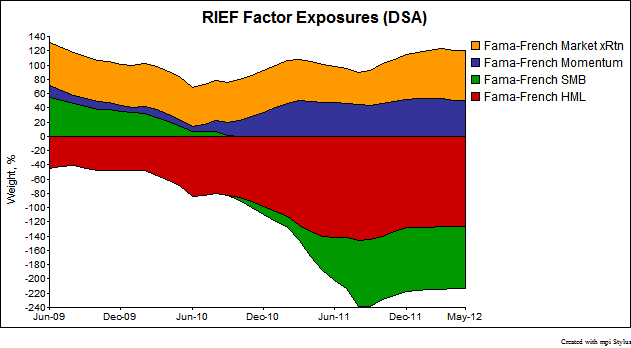
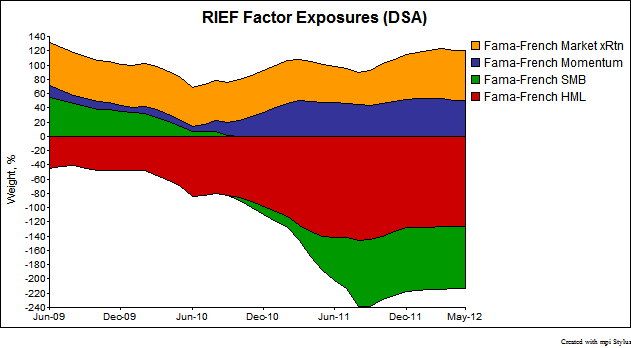
The Chart shows us consistent and increasing positive exposure to the market and momentum (growth), and an increasingly negative exposure to small-cap and value premiums, throughout the period to present.
As seen in the below chart, the majority of RIEF’s returns can be explained by their exposures to the Fama-French factors. Further, the variation and the magnitude of the returns are captured quite well.

When discussing the first half of 2009, Jim Simons, RenTech’s founder and then CEO, said, “The fund has its own mind and doesn’t like some of the stocks that the rest of the world likes.” But what has transpired since then looks to be a different story.
All four long/short observed exposures contributed positively to the fund’s performance in the past 3 years. Timing wasn’t everything though, the fund also produced positive alpha (selection).
For this period, at least, the market certainly liked what RIEF’s “mind” liked.

Footnotes
- 1MPI conducts performance-based analyses and, beyond any public information, does not claim to know or insinuate what the actual strategy, positions or holdings of the funds discussed are, nor are we commenting on the quality or merits of the strategies. This analysis is purely returns-based and does not reflect actual holdings. Deviations between our analysis and the actual holdings and/or management decisions made by funds are expected and inherent in any quantitative analysis. MPI makes no warranties or guarantees as to the accuracy of this statistical analysis, nor does it take any responsibility for investment decisions made by any parties based on this analysis.