Yale joins the SpaceX club
MPI estimates that SpaceX contributed nearly 40% of Yale’s FY26 investment gain, with hedge-fund ties offering clues to how Yale and Penn gained exposure.
Yale’s 26.3% FY26 return puts it among a group of elite endowments that appear to have benefited handsomely from SpaceX. MPI’s returns-based analysis in MPI Stylus PRO estimates that SpaceX contributed approximately 10 percentage points—nearly 40% of Yale’s annual gain—in addition to the contribution captured by our broader venture-capital factor.
Yale’s result also provides another check on our earlier research. In Before the Disclosure: Identifying SpaceX Exposure in Elite Endowments, we used annual endowment returns through FY25 to estimate SpaceX exposure across elite institutions. We augmented our standard set of public- and private-market factors with a SpaceX return series derived from historical valuations. That analysis identified meaningful excess SpaceX exposure at Yale—above the Ivy average, though below UNC and Harvard.
The estimated exposures suggested two broad FY26 scenarios: returns around 20% for portfolios with limited incremental SpaceX exposure, and closer to 30% for those with substantial exposure. With eight schools now reporting, Brown, Princeton and Dartmouth have landed closer to 20%, while Harvard, Stanford, Penn and now Yale have joined the “closer to 30%” group, consistent with the pattern discussed in our Harvard analysis.
MIT remains the exception. As we discussed in SpaceX Gains and the MIT Puzzle, its 10.3% return raised questions about a potential equity hedge, digital-assets exposure and the disappearance of its earlier incremental SpaceX signal.
Each newly reported return also becomes an additional observation for updating the model. We rerun the analysis as results arrive, refining estimates of both current exposures and their historical paths. The charts below therefore incorporate Yale’s FY26 result; they show updated estimates, while the earlier scenarios used information available through FY25.
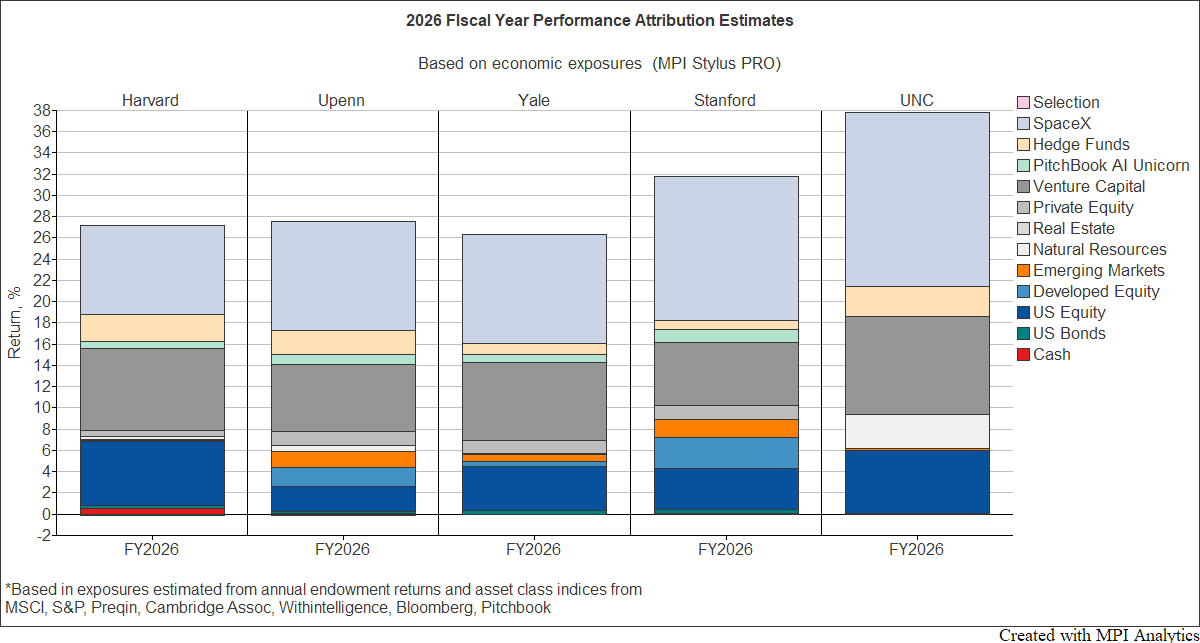
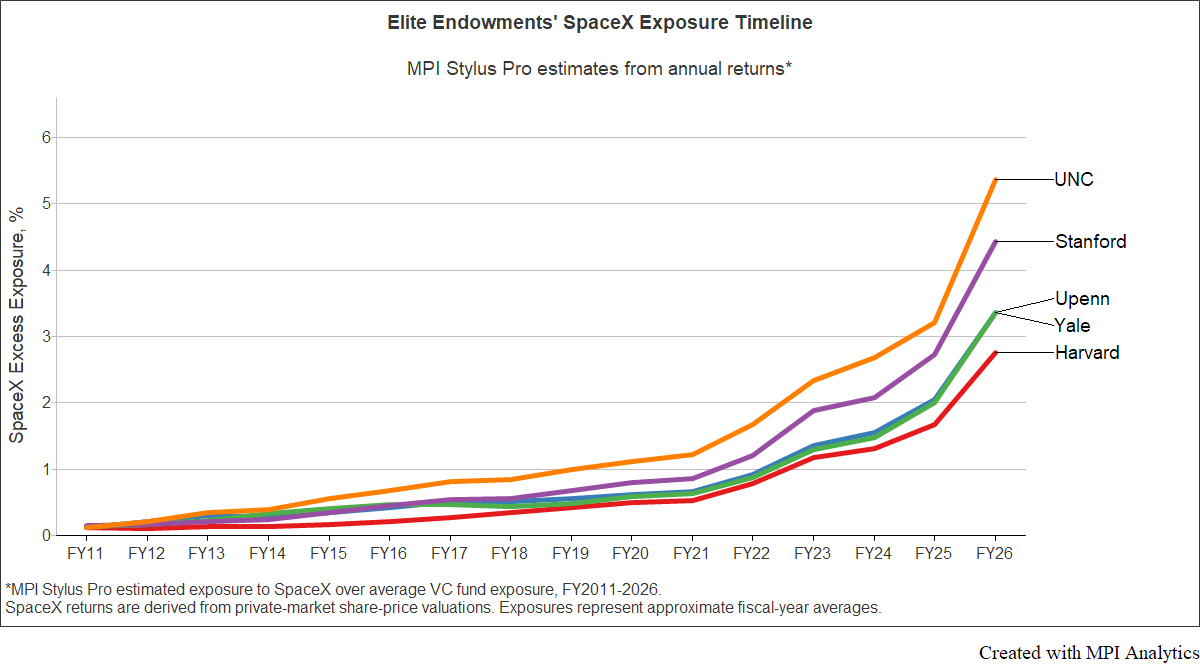
Our estimates place Yale alongside Penn, with larger SpaceX contributions at Stanford and UNC and a somewhat smaller contribution at Harvard. Yale’s estimated SpaceX exposure also closely tracks Penn’s over time, as the chart below shows, suggesting a possible common investment channel.
Public reporting offers a clue. The Wall Street Journal reported in May that Yale and Penn had been clients of Darsana Capital Partners, which first invested in SpaceX in 2019. By the time of that report, SpaceX represented nearly 60% of Darsana’s assets. Old Well Labs separately identified Penn’s disclosed commitment to Darsana’s primary fund.
Darsana therefore offers a plausible common route for some of that exposure, although these disclosures do not establish either endowment’s investment amount or explain the modeled exposure before 2019.
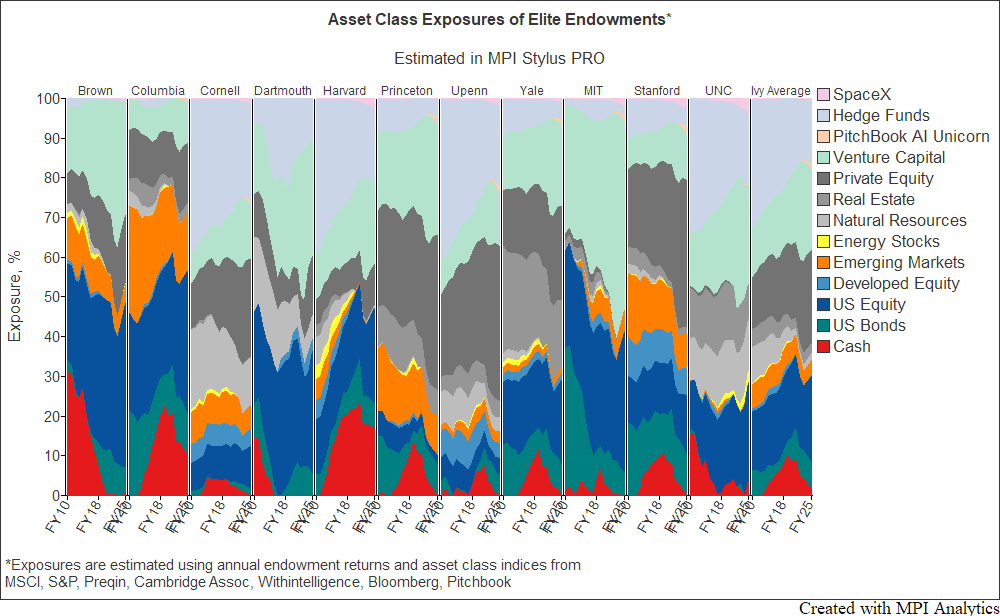
Exposure to a single company such as SpaceX or a theme such as AI can span private investments, public equities and alternative strategies, creating concentrations that asset-class labels alone may obscure. Returns-based analysis provides an important portfolio quality-assurance check by estimating economic exposures across the portfolio and testing whether its behavior aligns with the intended diversification.
We haven’t included WashU in this comparison. Stay tuned for that story.
Explore the MPI Transparency Lab and download individual endowment reports for Harvard, Yale, Princeton and other elite schools featuring MPI Stylus PRO estimates of economic exposures and risk, along with stress tests and scenarios.
Technology Solutions
Trusted by